Although Fair Trade chocolate may be a relatively new movement, the conditions that it tries to prevent are not.
When you take a bite into that luscious chocolate bar, source of ecstatic pleasure, do you stop to think about who grew the cacao that made your chocolate fantasy possible? Possibly one of the more than 15,000 child slaves working on cacao farms in west Africa. Does that chocolate still taste good?
By the way, did I mention that cacao farming has stripped the world of hundreds of thousands of acres of rainforest? Or, that despite the fact that the U.S. alone spends $13 billion a year on cocoa products, many cacao farmers are impoverished?
The statistics are sobering, yet large chocolate manufacturers still insist that, because of the way cocoa is traded at global markets, it is impossible for them to tell which cacao is grown by slaves and which isn’t. Estimates are that up to 40% of cocoa is slave grown. And you thought Abe Lincoln abolished slavery.
Rather than horrify you further with statistics (which hopefully isn’t necessary – hopefully you’ll have already decided that you want no part in promoting such an industry), here are a few options for you.
How to Support Fair Trade Chocolate
1) Look for products that are certified Fair Trade chocolate. When farmers and laborers are paid a fair price for the products they produce, rather than being exploited for cheap labor, that is considered “Fair Trade.” Because they are paid a fair wage, producers can avoid cost-cutting practices that sacrifice quality and are destructive to the environment. For example, Fair Trade chocolate is typically organic and shade-grown, meaning it is grown under the canopy of the rainforest rather than in a clear cut field.
Fair Trade products include coffee, tea, rice, fresh fruit, juices, sugar, honey, sports balls, wine, flowers, and our favorite, cocoa. Fair Trade chocolate certification is based on the standards set forth by Fairtrade Labeling Organizations International, a consortium of trade groups throughout the world who establish the criteria for all Fair Trade products, including Fair Trade chocolate. A similar movement is called Equi-Trade.
2) Limit, or stop, your consumption of mass-market chocolate. I know that may be hard if you have an addiction to, say, Snickers. All I can tell you is that after having once visited a banana plantation, wherein the workers lived in desolate concrete block houses and worked in the scorching heat, with giant billboards on every corner warning about what to do when overcome by pesticides, I swore to myself never to eat another non-organic banana.
If I am even tempted to, which I’m generally not, all I have to do is put myself back on the banana plantation. Try picturing your favorite 12 year-old working under the grueling African sun and being beaten all day so that you can enjoy your cheap candy bar, and that will make it easier to give them up.
3) Demand that your chocolate manufacturers and elected representatives take action to ensure that cacao is produced without slavery. Learn more about how to do this by visiting Global Exchange, an organization that offers many ways to help ensure fair labor standards worldwide.
4) Buy organic. Organic and Fair Trade chocolate really go hand in hand, and you will find that many organic products are Fair Trade and vice versa. Hopefully it already makes sense to you that spraying crops with pesticides and then harvesting and consuming those crops means you are eating pesticides. Yum! So that’s one reason to buy organic. Also, because organic farms are routinely inspected in order to maintain their organic certification, it is more difficult for them to exploit their workers without it being noticed.
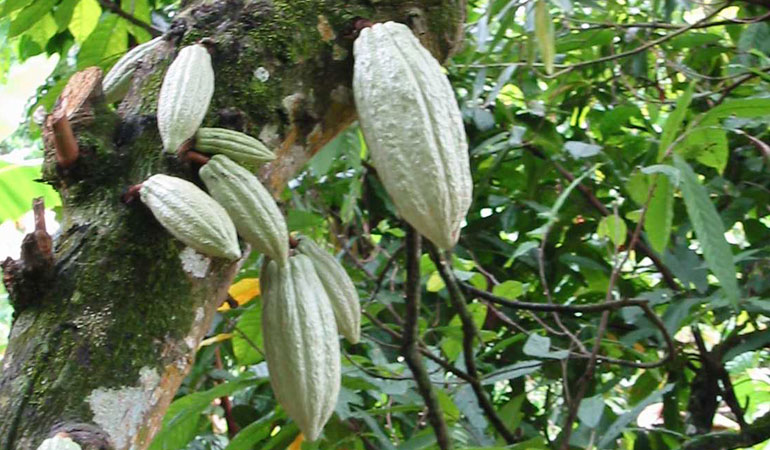
Another reason to buy organic is that organic cacao is typically shade grown, meaning it is grown under the canopy of other rainforest plants rather than in deforested swaths. Cacao plants actually do much better in shade. It’s their natural environment, and the small flies and midges that fertilize the plants only exist in the detritus found littering the rainforest floor. Shade grown cacao is much more resistant to disease. Top that off with the greater biodiversity found on an organic, shade-grown cacao farm versus a deforested plantation.
Plus, it’s just prettier! If you have ever seen a deforested plantation and then a shade-grown plantation, you’ll notice the difference immediately. In fact, on a trip to Costa Rica, I drove by several shade-grown coffee plantations without even realizing they were plantations! Someone had to point it out to me.
5) Support the efforts of the World Cocoa Foundation, whose mission is to support a sustainable cocoa economy through economic and social development and environmental conservation in cocoa growing communities.
6) Adopt a chocolate tree! Support the efforts of The University of the West Indies, whose International Cocoa Genebank is working to preserve the world’s wild cocoa varieties.
You can purchase Fair Trade chocolate and organic chocolate products from the following conscious manufacturers:
Green and Black’s (whose “Maya Gold” bar, which is delicious, was the world’s first Fair Trade chocolate bar) Dagoba Divine Equal Exchange
These are just a few of the many companies who insist on quality chocolate.
You can make a difference to the future of Fair Trade chocolate, one bite at a time.
As much as I enjoyed this informative article, it would be more informative if it named some non-fair trade OR fair trade companies. The tip about Snickers was helpful, but what are some more? I hate thinking I’m supporting something horrible, but I can’t change that unless I know what to avoid.
Thanks for your comment. Pretty much all the chocolate available for mass consumption through grocery stores and large retailers is not Fair Trade, and almost all Fair Trade chocolate is clearly labeled as such. Some of our favorite Fair Trade brands include Green and Black’s and Dagoba. There are other manufacturers listed at the end of the article.
There are too many chocolates that are not fair trade to list. But that’s why you have to look at the back of the chocolates label to look for the “certified fair trade” stamp. Trust me when I say, even though they are a bit more pricey, they are so delicious and worth every penny! Just be sure to always look for that stamp
Its really fantastic that you now wish to consume only “fairly traded” chocolate, however just because the chocolate company is fair trade certified, the chocolate is not necessarily so. This is because of two reasons, the first being that fair trade works on a mass balance system. The company, in order to get the symbol must buy the mass of cocoa required to produce that particular chocolate, from fair trade. This also means that the indidvidual cocoa beans that go into the chocolate may not be true fair trade beans, as the fair trade beans could have been used elsewhere. Point number 2, there have been several instances where non-fair trade cocoa beans have been mixed with fair trade cocoa beans at the source (not even by the company producing it). This is because cocoa is something which is bought in mass.
Let us take a case study to better understand this concept. Cadbury, is known to be affiliated with fair trade, despite heving only a few of it’s chocolate bars certified (it only has a few of one flavour certified). This misconception is largely due to media hype and lack of onsumer awareness. The first problem explained above is also something cadbury faces. This came to light by a twitter twweet. When asked by a fan how much of the cocoa in one cadbury bar is made of fair trade cocoa. Cadbury responded that it does no know. However it buys 16000 tonnes of fair trade cocoa. Thus not all cadbury bars really have the symbol. Those in india do not. And even if they do they might be fake.
Additionally it must be noted that many fair trade initiatives do not reach the people in ivory coast, Africa. Thus no chocolate is 100% safe.
If you feel guilty, my suggestion os to stop consuming chocolate (like I have). It will not be easy at first, but worth it in the end. You see this initiative works as follows. If the demand falls so does the supply. Which means cocoa farmers will have to produce less for the same money. This means that they will make more profit and will not need slaves.
Anyway the choice is yours. If it helps i’m only 14 years old, my birthday is coming. And I used to have chocolate almost twice each day (breakfast and snack),sometimes more. I’ve stopped entirely now. Not wanting to consume the blood, sweat and tears of innocents younger than myself. So good luck!cI hope you choose to be a responsible citizen of the world.
Thanks Jagriti!!
Very well stated and very informative!!
Especially for a 14 year old!!
Your posting is very inspirational!
I’m 65 and have been a chocoholic for decades.
After reading elsewhere and here about
Fair Trade Chocolate not being so “Fair” to the farmers,
I’ve cut my chocolate intake to near 0.
Your posting added more details that I was not aware of,
particularly the process of buying in mass and mixing fair trade with non-fair trade.
Thanks for the info and taking the initiative to spread the word!!
Awesome article! I’m getting more and more into this kind of stuff every day. This world is a disgrace. A great way to begin was to go vegan! I’m vegan.
Thank you so much for posting this this is really helpful because i’m doing a school research paper on Chocolate Slavery and the solutions to it. I think that what chocolate manufactures are letting happen in Africa and South America is absolutely horrible and i’m only 16 years old.
Yes, it’s great that there are an increasing number of cacao grower cooperatives that are making their own chocolate, or selling to small chocolate companies who turn their cocoa beans into delicious chocolate bars without the evil middle man involved. Bean to bar is definitely the way to go when you’re buying chocolate bars and products.
This website is a great to look at fair trade chocolate because we are teaching children at school how fair trade chocolate grows and where you find it so thank you ever so much for this wonderful information its amazing to use in schools !!:)
Hi,
Does anyone know the breakdown of how much each worker gets paid in the chocolate business – both fair trade and non-fair trade? I have found this information out for banana workers but would love to teach my class about this for the chocolate trade.
Thanks.
I think fair trade chocolate is horrible and it is the bottom of the barrel. Give me the good chocolate and coffee anytime as I cannot stand the junk purchased with the fair trade label which is rubbish.
While we agree that not all Fair Trade chocolate is good, we don’t agree that all Fair Trade chocolate is bad, either. There are a number of excellent Fair Trade chocolates, and, given the choice between a great tasting fairly traded item vs. not, we will choose the Fair Trade!
Fair Trade Chocolate and Coffee is rubbish. I will purchase nothing that has Fair |Trade on it knowing full well it is sub-standard and should have that warning on all packages. It is not top quality far from it. Just a big rip off.
I agree that some packages marked “Fair Trade” coffee offer a product that doesn’t taste so great. I’ve been burned that way more than once. Perhaps it sits on the shelf and gets stale or maybe these small producers don’t have great processing techniques and flavor is lost.
But there are standards and balance. Hawai’i offers coffee (and chocolate) that’s high quality, fair trade certified, organic and made in the USA. Good products cost a little more.
Why consume cheap chocolate that contains additives to enhance flavor?
Just an FYI, Camino chocolate who are based in Canada for the last 16 year, were certified long before Green and Blacks. It wold be nice if you added them to your list.
It is also important to note that sometimes growers are not certified fair trade or organic because it is expensive and they wish to be competitive though they follow those same practices. I don’t know a lot about chocolate, but I volunteered on a coffee co-op which was not certified anything but I have met some of the farmers and see how they work and they are affiliated with a British and American group that promotes the same things as fair trade and organic but without certification. Although, sometimes they say they need pesticides to fight bad bugs which have completely destroyed some people’s crops.
Also interesting to note that many Guatemalan coffee farmers drink instant because real coffee is too expensive and many, probably most, chocolate farmers have never tasted chocolate. I love both so much, and I sort of want to support farmers who work hard to make sure they get money (fair trade unless I know otherwise that they are good) but I’m not sure if I am just trying to legitimize my chocolate eating to myself.


 Although Fair Trade chocolate may be a relatively new movement, the conditions that it tries to prevent are not.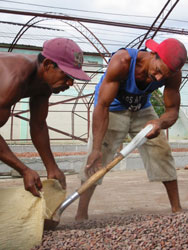




As much as I enjoyed this informative article, it would be more informative if it named some non-fair trade OR fair trade companies. The tip about Snickers was helpful, but what are some more? I hate thinking I’m supporting something horrible, but I can’t change that unless I know what to avoid.
Hi Anya,
Thanks for your comment. Pretty much all the chocolate available for mass consumption through grocery stores and large retailers is not Fair Trade, and almost all Fair Trade chocolate is clearly labeled as such. Some of our favorite Fair Trade brands include Green and Black’s and Dagoba. There are other manufacturers listed at the end of the article.
Have a chocolatey day!
You do know that Dagoba is owned by Hershey, right? Since 2006.
Push U.S. (or US affiliated) companies like Mars, Hershey, Cadbury, Nestle to source all their cacao from Fair Trade growers.
There are too many chocolates that are not fair trade to list. But that’s why you have to look at the back of the chocolates label to look for the “certified fair trade” stamp. Trust me when I say, even though they are a bit more pricey, they are so delicious and worth every penny! Just be sure to always look for that stamp
Its really fantastic that you now wish to consume only “fairly traded” chocolate, however just because the chocolate company is fair trade certified, the chocolate is not necessarily so. This is because of two reasons, the first being that fair trade works on a mass balance system. The company, in order to get the symbol must buy the mass of cocoa required to produce that particular chocolate, from fair trade. This also means that the indidvidual cocoa beans that go into the chocolate may not be true fair trade beans, as the fair trade beans could have been used elsewhere. Point number 2, there have been several instances where non-fair trade cocoa beans have been mixed with fair trade cocoa beans at the source (not even by the company producing it). This is because cocoa is something which is bought in mass.
Let us take a case study to better understand this concept. Cadbury, is known to be affiliated with fair trade, despite heving only a few of it’s chocolate bars certified (it only has a few of one flavour certified). This misconception is largely due to media hype and lack of onsumer awareness. The first problem explained above is also something cadbury faces. This came to light by a twitter twweet. When asked by a fan how much of the cocoa in one cadbury bar is made of fair trade cocoa. Cadbury responded that it does no know. However it buys 16000 tonnes of fair trade cocoa. Thus not all cadbury bars really have the symbol. Those in india do not. And even if they do they might be fake.
Additionally it must be noted that many fair trade initiatives do not reach the people in ivory coast, Africa. Thus no chocolate is 100% safe.
If you feel guilty, my suggestion os to stop consuming chocolate (like I have). It will not be easy at first, but worth it in the end. You see this initiative works as follows. If the demand falls so does the supply. Which means cocoa farmers will have to produce less for the same money. This means that they will make more profit and will not need slaves.
Anyway the choice is yours. If it helps i’m only 14 years old, my birthday is coming. And I used to have chocolate almost twice each day (breakfast and snack),sometimes more. I’ve stopped entirely now. Not wanting to consume the blood, sweat and tears of innocents younger than myself. So good luck!cI hope you choose to be a responsible citizen of the world.
You are very well spoken!
Thanks Jagriti!!
Very well stated and very informative!!
Especially for a 14 year old!!
Your posting is very inspirational!
I’m 65 and have been a chocoholic for decades.
After reading elsewhere and here about
Fair Trade Chocolate not being so “Fair” to the farmers,
I’ve cut my chocolate intake to near 0.
Your posting added more details that I was not aware of,
particularly the process of buying in mass and mixing fair trade with non-fair trade.
Thanks for the info and taking the initiative to spread the word!!
Guittard Chocolate company located in California. is a fair trade chocolate company.
Awesome article! I’m getting more and more into this kind of stuff every day. This world is a disgrace. A great way to begin was to go vegan! I’m vegan.
Thank you so much for posting this this is really helpful because i’m doing a school research paper on Chocolate Slavery and the solutions to it. I think that what chocolate manufactures are letting happen in Africa and South America is absolutely horrible and i’m only 16 years old.
Yes, it’s great that there are an increasing number of cacao grower cooperatives that are making their own chocolate, or selling to small chocolate companies who turn their cocoa beans into delicious chocolate bars without the evil middle man involved. Bean to bar is definitely the way to go when you’re buying chocolate bars and products.
This website is a great to look at fair trade chocolate because we are teaching children at school how fair trade chocolate grows and where you find it so thank you ever so much for this wonderful information its amazing to use in schools !!:)
Hi,
Does anyone know the breakdown of how much each worker gets paid in the chocolate business – both fair trade and non-fair trade? I have found this information out for banana workers but would love to teach my class about this for the chocolate trade.
Thanks.
I think fair trade chocolate is horrible and it is the bottom of the barrel. Give me the good chocolate and coffee anytime as I cannot stand the junk purchased with the fair trade label which is rubbish.
Dear Disgusted,
While we agree that not all Fair Trade chocolate is good, we don’t agree that all Fair Trade chocolate is bad, either. There are a number of excellent Fair Trade chocolates, and, given the choice between a great tasting fairly traded item vs. not, we will choose the Fair Trade!
WOW this was so helpful for chocolate ethics class thanks admin guy!!!! #SWAG
Fair Trade Chocolate and Coffee is rubbish. I will purchase nothing that has Fair |Trade on it knowing full well it is sub-standard and should have that warning on all packages. It is not top quality far from it. Just a big rip off.
I agree that some packages marked “Fair Trade” coffee offer a product that doesn’t taste so great. I’ve been burned that way more than once. Perhaps it sits on the shelf and gets stale or maybe these small producers don’t have great processing techniques and flavor is lost.
But there are standards and balance. Hawai’i offers coffee (and chocolate) that’s high quality, fair trade certified, organic and made in the USA. Good products cost a little more.
Why consume cheap chocolate that contains additives to enhance flavor?
wow thats mean you should buy fair trade products. It’s fair for everyone!
Just an FYI, Camino chocolate who are based in Canada for the last 16 year, were certified long before Green and Blacks. It wold be nice if you added them to your list.
It is also important to note that sometimes growers are not certified fair trade or organic because it is expensive and they wish to be competitive though they follow those same practices. I don’t know a lot about chocolate, but I volunteered on a coffee co-op which was not certified anything but I have met some of the farmers and see how they work and they are affiliated with a British and American group that promotes the same things as fair trade and organic but without certification. Although, sometimes they say they need pesticides to fight bad bugs which have completely destroyed some people’s crops.
Also interesting to note that many Guatemalan coffee farmers drink instant because real coffee is too expensive and many, probably most, chocolate farmers have never tasted chocolate. I love both so much, and I sort of want to support farmers who work hard to make sure they get money (fair trade unless I know otherwise that they are good) but I’m not sure if I am just trying to legitimize my chocolate eating to myself.
Well explained and very well detailed. Good job kid
i feel sorry for the people who work hard and get nothing in return from us selfish people
AWESOME TY!!!!!!!!
thank you it was helpful
I love chocolates , love this post. Thanks for sharing this post with us.