


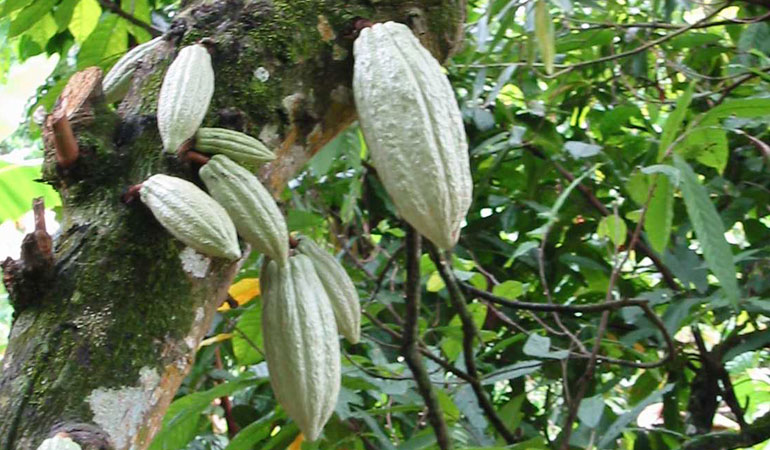
Chocolate history starts out in Latin America, where cacao trees grow wild. The first people to use chocolate were probably the Olmec of what is today southeast Mexico. They lived in the area around 1000 BC, and their word, “kakawa,” gave us our word “cacao.” Unfortunately, that’s all we know. We don’t know how (or even if) the Olmec actually used chocolate.
We do know, however, that the Maya, who inhabited the same general area a thousand years later (from about 250-900 AD), did use chocolate. A lot. And not just internally. It is with the Maya that chocolate history really begins.
The cacao beans were used as currency. 10 beans would buy you a rabbit or a prostitute. 100 beans would buy you a slave. Some clever person even came up with a way to counterfeit beans – by carving them out of clay. The beans were still used as currency in parts of Latin America until the 19th century!
The Maya also used chocolate in religious rituals; it sometimes took the place of blood. Chocolate was used in marriage ceremonies, where it was exchanged by the bride and groom, (I think I will have to revive this tradition), and in baptisms. They even had a cacao god.
But the Maya prepared chocolate strictly for drinking. Chocolate history doesn’t include solid chocolate until the 1850s. Except for that, the way the Maya prepared chocolate wasn’t too much different from the way it’s prepared today. First, the beans were harvested, fermented, and dried. The beans were then roasted and the shells removed, and the rest was ground into a paste. The paste was mixed with hot water and spices, such as chili, vanilla, annatto, allspice, honey, and flowers. Then the mixture was frothed by pouring it back and forth between two containers. The Maya thought the froth was one of the best parts. Chocolate was also mixed with corn and water to make a sort of gruel. It was probably similar to the chocolate and corn drink pinole, still enjoyed in Latin America today.

If dollar bills were edible, would you eat them? Probably not, unless you had some to spare. The same was true of the Maya – usually only the rich drank much chocolate, although working folks probably enjoyed chocolate every now and then too. The rich enjoyed drinking their chocolate from elaborately painted chocolate vessels. Emperors were buried with jars of chocolate at their side. Clearly, they wanted to make chocolate history themselves.
So it’s no surprise that when the Aztecs conquered the Maya, they kept the chocolate tradition alive. From about 1200-1500, the Aztecs dominated the region and continued using cacao as currency. Because cacao could not grow in the capital city, Tenochitlan (where Mexico City is today), it had to be imported through trading and, what else? Taxes!
The Aztec drank their chocolate much like the Maya, although they sometimes liked it cold. One chocolate history legend has it that the Aztec god Quetzalcoatl brought cacao to earth and was cast out of paradise for giving it to man. Only the gods were fit to drink chocolate!
In 1502, Columbus and his son, Ferdinand, were in the area, doing the usual conquering and such, when they came across a dugout canoe laden with supplies. They promptly captured it and ordered the natives to carry the loot on board their ship. In the process, somebody spilled some cacao, and the natives ran for the beans “as if an eye had fallen from their heads,” according to Ferdinand. Columbus could have been known as the first white guy to “discover” chocolate, but he blew his chance to make chocolate history by forgetting all about the incident.
In 1519, Cortez and his cronies arrived in the Aztec capital, where cacao trading was in full force, and Montezuma, the Aztec ruler, was rumored to have a billion beans in storage. They tried chocolate, hated it, and one writer eloquently called it “more a drink for pigs than a drink for humanity.” Without sugar, cacao was fairly bitter.
After Cortez and pals conquered the Aztecs, they kept right on using cacao as currency. By this time a rabbit cost 30 cacao beans. Must have been inflation. But chocolate history would soon change forever, because Cortez also kept right on conquering other people. Conveniently, the Spanish had taken over lots of Caribbean islands. And on those islands was sugar. Next thing you know, somebody put sugar in chocolate and everybody was clamoring for the stuff.
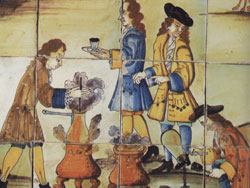 Chocolate History in Church
For a while, the Spaniards kept the chocolate secret to themselves. And when chocolate first made it to Spain, it was considered a health food and a medicine. Doctors prescribed it for curing fevers, cooling the body, aiding in digestion, and alleviating pain. The church also approved it as a nutritional supplement to take while fasting. (That might have been a bad choice, as one bishop was poisoned for refusing to allow his parishioners to bring chocolate to mass.)
None of that lasted long. Chocolate was too good to be reserved for medicine only. Plus, it was the first caffeine to reach Europe, beating out coffee and tea by a few years. Chocolate doesn’t have much caffeine, but when you’ve never had the stuff, less is more. Other than adding sugar, little had changed in the preparation of chocolate, although the Spaniards frothed theirs by using a little stick called a molinillo, which you would place between your palms and whirl to create the froth.
Chocolate soon made its way to the rest of Europe. Well, the rest of the rich people in Europe, that is. It was a big hit in Louis XIV’s court. In 1657, the first chocolate house opened in London. You could go to the chocolate house, have a drink, play some cards, talk politics, that sort of thing. (Interestingly, Mars is trying to open a new chapter in the chocolate history books by reviving the chocolate house tradition. They’ve opened Ethel M’s, an upscale chocolate boutique designed for hanging out.) Eventually, cinnamon and milk found their way into the mix.
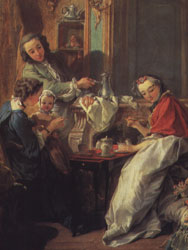
As chocolate spread through Europe, the demand took off. To keep up with the demand, plantations sprung up, and thousands of people were enslaved to produce cacao. Rather than rely on the Spanish, the British, the Dutch, and the French started their own plantations, taking cacao out of Central America and planting it in their own territories – Sri Lanka, Venezuela, Java, Sumatra, the West Indies, and Africa. Up until this point, most chocolate was made from a variety of cacao called criollo. But because forastero beans are easier to grow (never mind that they don’t taste as good), they were the ones that got shipped ’round the globe, marking another turning point in chocolate history. Today, 90% of cacao is forastero.
As the supply increased, prices went down, and chocolate became increasingly available to the little guy. And when the little guy got a hold of it, chocolate history really took off. Like in the early 1800s when Coenraad Van Houten, a Dutchman, created the cocoa press, which smushed the beans and expelled the cocoa butter (fat), leaving just the cocoa behind. He also came up with a way to wash the cocoa in an alkali solution (hence “Dutch” cocoa) to make it easier to mix with water. Who hasn’t had the experience of cocoa globbing up on their spoon?
Chocolate History Firms Up

In the 1850s, Englishman Joseph Fry changed my life by adding more cocoa butter, rather than hot water, to cocoa powder and sugar. The world’s first solid chocolate was born.
In 1875, Daniel Peter and Henri Nestle added condensed milk to solid chocolate, creating a milk chocolate bar.
In 1879, Swiss chap Rudolphe Lindt invented the conch, a machine that rotated and mixed chocolate to a perfectly smooth consistency.
By 1907, Milton Hershey’s factory was spitting out 33 million kisses per day.
Advertising and World Wars (where soldiers got chocolate as part of their rations) just kept increasing the popularity of the stuff. Today, over 3 billion tons of cacao supplies a 35 billion dollar chocolate industry.
Chocolate history has had its dark side. Slave-like conditions and child labor still produce much of the world’s chocolate. Gazillions of acres of rainforest have been razed to make room for cacao trees. Yucky tasting Forastero beans threatened to take over entirely.

Fortunately, some new trends have sprung up. You might say chocolate history is returning to its roots. Chocolate connoisseurs are buying more and more Fair Trade and single origin chocolates, which help ensure better working conditions for farmers and help preserve higher quality cacao varieties, like criollo. The higher quality beans are grown in an environment that is very close to natural, thereby helping preserve the rainforest. And chocolate snobs devote more time to savoring the chocolate rather than shoveling it in. That’s got to save a few trees right there.


Excellent!! Learnt a lot about chocolates.Thank you.
this history about chocolate sure is interesting I think its cool
AWSOME HELPED ME ON MY READING HOMEWORK:)
i used this website for a scence fair research review paper. Very heplful!! THANKS
Hehe, umm….you said scence *.* but i know what you meant ;D
it helped me lot in my projects!
Good it helped me too
I use it for bathing!!!!
I think this website was very educational.THANKS A LOT!!!!!
knowlegible,amazing,fasinating story about chocolate!!!!!
this is awesome.I learned alot
using some information for a speech. Nice job!
I LOVE strawberries dipped in chocolate!!!!!!!!!!
good show
this was the bomb diggitty
Lovely stuff, but who actually made the chocolate first this is what I was looking for. . .
But till now, I can’t find it. 🙁
…..so who’s craving some chocolate???? 😀
Me I love chocolate💖💖💖💖💖💖💖💖💖
**bubblegum**
Saved my butt on a research report in class!
This helped a lot on my 8th grade I-search paper.
THANKS!!!
This helped a lot on my 8th grade I-search paper.
THANKS!!!
same
Thanks learned a lot
I love chocolate It helped me thank you 😉
I have facebook look me up!!!!
Great info amazing used it for my project
it was a fantastic experience.i never knew that chocolate had such a great history. i have relished the history as much as the yummy chocolate. Satyan
This is great!!!as a student I learnt lots for my science fair
I live for chocolate
I am suddenly craving chocolate. Be right back 🙂
As a student and my topic in school is chocolate, my homework was to create a PowerPoint about cacao so I’ve learnt so much from this website and I agree with all of you which left a comment.
Well said. Well said.
Queen Bee
Me too!
I am so interested i will make a public speech at my school Albert einstein academy
Oh, yay! This website has helped me on my History project.
thanks so much this helped a lot with my science fair project!!!!!!!!!!!!!!!!!!!!!!!!!!!!!!!!!!!!!!!!!!!!!!!!!!
Chocolate is amazing. And now that i know it has an awesome history as well, it makes it even more amazing.
Thankyou for putting this up, much appreciated.
Why do you say that Fry made the first solid chocolate, when the first one that made it was Doret in Turin in 1778? Yea he didn’t make an industrial chocolate bar, he made little chocolates, but still they were solid indeed, 50 years before solid chocolate was born according to your article.
Oh my oh my i like chocolate at all times of the day. Yum yum chocolate is goody goody
it was very good for my assessment ty
AMAZING info I used is for my speech at school
COOL WEBSITE LOVED IT PEEPS
CHOCOLATE RULES! Am using this info for a school project
The History of chocolate is AMAZING! So interesting!<3 <3 <3 <3 <3 <3
save the earth thats the only planet has chocolate
Hi, I am doing a research project and I am hoping to use your website. Where are your sources for this?
the hittite culture of mesopotamia around 1800 years bc have a word for chocolate. however chocolate is supposed to have originated in central america about the same time. were there trade connections possibly by phoenicians or earlier seafarers ? both cocaine and opium have been found in egyptian mummies. hittite for chocolate is very similar. look up hittite word list.
I was concerned that my comment of yesterday has been excised. I said that hittite an ancient language of the middle east has a word for chocolate. I asked was it possible that there was trade with america at that time? Today i checked some hittite word lists but as yet was unable to find the word in hittite. I am sure I saw it there previously. However i checked sumerian word lists from an even earlier era and there it was translated from cunieform. scruipthttp://history-world.org/sumerianwords2.htm, the word for chocolate being a similar sounding word SUKULUTU, which is just as close to the original mayan word.
To back up my contention that there was trade between these far regions at least three thousand years before present, I checked the reports that nicotine, cocaine and opium have been detected in ancient Egyptian mummies. This is not a fantasy.
So why not chocolate traded by the same means?
Please check my evidence before deciding it could not be true.
Cedric Williams
great !! this article helped me a lot in my report 🙂 my classmates was amazed. 🙂 Thumbs Up!!!
I believe Sir Hans Sloane had a ;part to play in bringing drinking chocolate to Britain and it coming to the notice of the Cadbury Brothers. That was a very important event in chocolate history at least fro Britain.
This helped a lot! I learned some interesting things! Thank you for making this website, it really helped!
This helped a lot with Language arts assignment, you wouldn’t believe how much importance they put on chocolate in my curriculum…
This helped a lot for my report ty!!!!!!!!
I love chocolate
So great! This article is so helpful on my task. Thank you very much
Wow Nice Article
Thank you, great article and summary of the history of the humble chocolate bar – so much more than we think! The forever evolving world of chocolate – I wonder where how the chocolate market will look in 10-20 years time?
Epic Website for LAMDA speech – if anyone knows what i mean?!:)
i got fat from chocolate but thanks for helping me with this project!!!
Awesome content! Thanks for this bit of history about chocolate!
chocolate😍 where would i b without chwocoyet
The pope talks to Mara inhabitants and he finds out that Jesus visits them twice a year. Intrigued, the Pope replies “twice a year, every year?!? It’s been two millennia since He came to Earth and we are still waiting for his second coming”. Mars inhabitants tell the pope that maybe Jesus didn’t like Earth Chocolate. Again intrigued, the pope asks “chocolate?” Yea, the martians reply, everytime he visits we gather the best chocolate we have and offer it to Him before he leaves. Why, what did you guys do the first time He came to Earth?
Pretty good info! Only thing I didn’t like was it didn’t have any quotes.
https://facts-about-chocolate.com/chocolate-quotes/